In a bid to begin a new era of Mars
exploration for Europe, the European Space Agency (ESA) and the Russian
Federal Space Agency (Roscosmos) are set to send a robotic probe to Mars Monday March 14,2016 to find if the planet has traces of alien life.
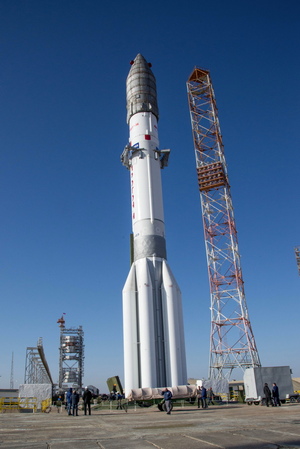
Named "ExoMars 2016", the ESA-Roscosmos mission is set to lift off from
Baikonur Cosmodrome in Kazakhstan on a Russian Proton rocket at around 3
p.m., marking the start of a seven-month journey to the Red Planet.
The first phase of the mission will have the Trace Gas Orbiter (TGO) and
Schiaparelli lander -- an entry, descent and landing demonstrator.
TGO will make a detailed inventory of Mars' atmospheric gases, with
particular interest in rare gases like methane, which implies that there
is an active, current source.
"TGO aims to measure its geographical and seasonal dependence and help
to determine whether it stems from a geological or biological source,"
the ESA said in a statement.
Meanwhile, Schiaparelli will demonstrate a range of technologies to
enable a controlled landing on Mars in preparation for future missions.
After a seven-month cruise, the lander will separate from the TGO on
October 16 and land on Mars on October 19,2016 for several days of
activities.
TGO will then enter orbit around the Red Planet ahead of its exciting multi-year science mission.
It will also serve as a data relay for the second ExoMars mission,
comprising a rover and a surface science platform, planned for launch in
2018. It will also provide data relay for NASA rovers.
European, Russian space agencies launch mission to Mars
Europe and Russia launched a joint mission Monday March 14,2016 to explore the
atmosphere of Mars and hunt for signs of life on the red planet.
The
unmanned ExoMars probe- a collaboration between the European Space
Agency and Roscosmos - took off from a base in Kazakhstan aboard a
Russian rocket.
Mission controllers in Darmstadt, Germany, said they began receiving a
signal from the spacecraft about 11 hours after launch, after it had
successfully separated from the rocket and deployed its solar wings to
continue on its journey.
It is expected to reach Mars in October 2016




No comments:
Post a Comment